Showing posts with label 1860s. Show all posts

Sep 9, 2014

Ordination of Native Methodist Ministers at Foochow, China

The week ending with Monday, the 22nd of November, was one of great and unusual interest to the friends of missions generally, and to the Methodist Episcopal mission particularly. The special occasion was the General Annual Meeting of the native helpers of that mission at Foochow, their examination, and the ordination of seven of their number to the office or order of deacons, and of four of the seven to the office or order of elders in the Methodist Church by Bishop Kingsley.

Tuesday, Wednesday, and Thursday were devoted to the examination of the native helpers on certain portions of the sacred Scriptures, and on the Discipline and regulations of the Methodist Church, and on sermons prepared by some of the helpers. The portions of the Bible and of the Discipline on which they were examined had been given out at the General Meeting held last year in October, as subjects of special study during the present year. Four sessions were held each of these three days. The helpers passed the ordeal very creditably. The missionaries and the most intelligent of the native preachers acted as examiners.

Friday and the forenoon of Saturday were occupied in the examination of the old helpers in regard to their personal character, and the examination of the new candidates for the position of student, or assistant helpers, and in the prosecution of such other business as was intimately connected with the work of the past, or the work of the following year. These sessions were presided over by Bishop Kingsley, assisted by the members of the mission, who translated for him. It was concluded to retain all of the old helpers and student helpers except four or five, some of whom offered their resignation, and a large class of new student helpers were received.

As has been the practice for several years, the evenings of Thursday, Friday, and Saturday, from 7 until after 9 o’clock, were devoted to the consideration of the important subjects, Spreading of the Gospel, the Bible Cause, and the Opium Question, respectively. These meetings were presided over by native Christians, who conducted themselves in a very creditable manner, introducing the subjects by appropriate remarks, after having engaged in singing, reading the Scriptures, and in prayer. They called upon the speakers in the order which had been fixed upon, the programme having been printed, with names of speakers and subjects to be discussed. Only three brief speeches were made by the missionaries during these three evening. While all the addresses made by the Chinese preachers were good, most of them were remarkably excellent and practical, and would have done credit to young men of American or English birth and education, as regards arrangement, thought, and manner. A synopsis of these addresses would make this article too lengthy.

The closing speech on the opium topic, delivered late Saturday evening by Hu Sing Mi – one of the seven subsequently ordained, who spent two or three years in New York city, and was a member of the Methodist Church on Twenty-Seventh-street – was remarkable for its humor and feeling, and for its arguments, facts, and illustrations. In the judgment of some, if not all of the foreigners who listened to it, it was the most elaborate and the most eloquent address they had ever heard from a Chinaman on that or any secular subject.

During the evening devoted to the subject of “Spreading the Gospel,” a list of the contributions made for that object by the native Christians connected with the Methodist missions during the past year was read, whereby it appeared that 311,742 cash – a little short of $300 – had been thus contributed. This fact is of a very encouraging nature. It is believed, however, that during the coming year the contributions for the spreading of the Gospel made by the native Churches will be very much larger. The native preachers, and assistant or student helpers, who are to labor in the district of Hing-Hua, between this and Amoy, it is understood have pledged themselves to raise $200 during the coming year; and those laboring in the district of Foo-Ching, this side of Hing-Hua, are pledged to collect $100 from their field.

After much thought, consultation, and prayer, it was decided by the Bishop and the mission to ordain as deacons certain seven of the “licensed” native preachers, and as elders certain four of that number. These men have been employed in preaching the Gospel from four or five years to over ten years each. In the love-feast, held on Sabbath morning, November 21st, these brethren had an opportunity of briefly expressing their feelings in view of their proposed ordination. They all seemed deeply impressed with the importance, solemnity, and responsibility of position in the Church they are to hold – the first ordained deacons of the Methodist Episcopal Church in China.


At the close of an impressive sermon on the character and conduct which it was binding on them to sustain and exhibit, delivered soon after the termination of the love-feast by one of the missionaries, Bishop Kingsley proceeded to ordain the seven to be “deacons in the Church of God.” The scene was solemn and impressive. It will not soon be forgotten by the crowded house which witnessed it.

In the evening of the Sabbath, four of the seven deacons were solemnly consecrated and ordained to the eldership by the Bishop – the Methodist missionaries and two American Presbyterian ministers who were present, joining with the Bishop in the imposition of hands on the heads of those who were thus set apart to the service of God in the holy ministry. The ordaining was followed by the administration of the Lord’s Supper, at which the foreign Christians, American and English, partook, as did a large number of Chinese Christians – estimated to over one hundred. The newly ordained deacons and elders assisted in the administration of the Supper on this interesting and memorable occasion.

The body of native preachers and student helpers met on Monday morning and received their appointments for the coming year.

The men who were ordained deacons or elders range from thirty to forty-six years of age. Three of them are brothers – on of them being the person who spent two or three years in study in New York. One is a graduate of the Mission Boarding-School, of which he was a member when Rev. Otis Gibson, now missionary to the Chinese in California, had charge of it. Another was a hard-working blacksmith when converted. He subsequently labored at the anvil, and at the same time, with unwearied application, studied the sacred Scriptures, which he placed near by, talking incessantly with his customers about the glorious Gospel. He soon developed such singular zeal and rare ability in public speaking that he was employed as native helper. The remaining two, one a literary man by profession, and the other, formerly a merchant and opium-seller, as well as opium-smoker, have already given good proof of their call to the ministry by their devoted labors and their abundant success in interesting their countrymen in the Gospel, and in leading them into the Church. The latter one, the oldest of the seven, is often referred to among foreign missionaries as brother Binkley’s man, from the circumstance that Rev. Mr. Binkley, who was obliged to return to the United States six or seven years since, was instrumental in his conversion.

These seven are in charge of Churches at very important centers. Mr. Binkley’s man is stationed at the principal city in Hing Hua prefecture – the literary man at the principal city in the district of Foo ’Ching, forty and seventy miles to the south-east of Foo Chow. The youngest and the second of the three brothers, in the corresponding cities of ’Ku-’tien and Ming-’Ching districts, one hundred miles and forty miles to the north-west and west of Foo Chow respectively. The eldest brother is in charge of the Church near which the Methodist missionaries live, and in which the annual meetings are held. The graduate of the Mission Boarding-School is in charge of the Church on East-street in the city of Foo Chow, and the zealous and eloquent blacksmith – learned in the Scriptures – is in charge of the Church located a mile from the south gate of the city in the great southern suburb.

The missionary work at this place and the surrounding country, under the auspices of the Methodist mission, is constantly increasing in interest and importance. It is making, month by month, greater and greater demands on the strength of its members, who number three ministers, all told. And yet one of them is under the grave necessity of leaving with his family for the United States next Spring. There will then remain two men. The three are already overburdened with their cares, responsibilities, and labors. “The harvest truly is plenteous, but the laborers are few. Pray ye therefore the Lord of the harvest, that he will send forth laborers into his harvest.” Who will come without delay and enter upon this great harvest-field and aid in gathering the sheaves into the garner of the Lord?

This sketch would be incomplete if a reference should not be made to the presents given Bishop Kingsley, on the Wednesday evening after the ordination services, at the usual time of holding the missionary weekly prayer-meeting. Five of the ordained men, the other two being away, without notice or warning walked into the room where the meeting was to be held, each conveying a valuable present, consisting of Japan or Foo Chow made lacquered boxes, of superior workmanship, and a beautiful fan, which some one subsequently suggested was intended for Mrs. Kingsley. On this their names had been neatly inscribed. Without a word they placed these things on the center-table, while they remained standing near it. The senior missionary addressed the Bishop, who arose, while the esteem in which he was held by them and the fraternal salutations and farewells of the ordained were presented to him. He replied in a brief speech, which was duly translated to them, in which he thanked them for the beautiful tokens given him, which he said he should value highly, and show his friends in America. He expressed his great pleasure in having met them, and his satisfaction in their character as Christian ministers.

Soon after this a member of the mission approached him with a heavy volume containing fifty or sixty large and superior photographic views of Foo Chow and the adjacent scenery, which he presented the Bishop in the name of the Methodist missionaries. He read a short and well-worded address to the Bishop, which expressed their gratitude for his services in his official capacity, and their sense of the profit they and their families had derived from his counsel and example during his brief sojourn with them, and their best wishes for his happiness and usefulness during the remaining portion of his trip around the world, as well as during his life, assuring him they would be glad to welcome him again at Foo Chow. The Bishop, who evidently was taken by surprise, remarked that he could not be expected to make a lengthy and appropriate reply to this address, and that he must be allowed to imitate the example of President Grant on similar occasions, and say simply with all his heart, “I thank you.” He subsequently examined with pleasure the valuable present of photographic scenes, as will his many friends in the United States, who many have the opportunity of looking it over.

Singing the hymn in Chinese and English, “Forever with the Lord,” a prayer in English by the Bishop, and a prayer in Chinese by one of the native ministers, constituted the prayer-meeting for that evening.

(This article was extracted from the Ladies’ Repository of 1870, possibly written by Justus Doolittle.)

Our China Missioin

Now we are off for Foo Chow. The boat is a beauty, the captain a gentleman. Next day we arrive at Double Island. Here Mr. Johnston, a missionary from Maine, resides. He occupies very good premises. His wife teaches a boarding-school, which is independent, and is supported, in part, by the labors of the girls. When Mr. J. first entered upon duty, in 1848, he found the prejudice against foreigners intense; arising from the coolie slave-trade, of which this island was the seat. But the influence of this is gradually subsiding. He has baptized forty since he arrived, and thinks his prospect fair. He is, however, about to remove his location, as the foreigners have deserted the island and gone to Swatow, and the natives are following them, so that the island will soon be nearly deserted. There is here a small temple of polished granite, admirably carved in alto relievo. It is to the goddess of Mercy, or Queen of Heaven, and reminds one of Mariolatry and the resemblance between Buddhism and Romanism.

On we go to Swatow, where we remain some time. It is a poor-looking place, on a low strip of land with here and there a green spot, but beyond that, presenting the appearance which the whole coast does of cold granite. Swatow contains about 20,000 inhabitants, a small number of whom are Europeans, who, however, are increasing. The custom-house officers are British. Mr. Hart has the general superintendence of them. Baron Meriton, a Frenchman, is collector at Foo Chow. January 1st we arrived at Amoy, in the neighborhood of which was an insurgent force, that caused much uneasiness. We were all day discharging cargo, the most valuable of which was opium, though there was grain of various kinds, chiefly different species of pulse. Here is a mission superintended by Mr. Stronach. The shipping in the harbor is nearly all junks, attractive by their gaudy decorations in anticipation of New-Year, which in China begins the twenty-sixth of the month, January, and remarkable for the cannon they carry, which is said to be a necessary defense against pirates in these waters. The foreign shipping is mostly English - not an American flag to be seen. Much of the shipping is damaged, probably by the typhoon.

Next day we are off, and on the following morning we are approaching the mouth of the Min. It was Sabbath, and I proposed preaching, but we could not get more than three or four together, and as the captain could not leave the deck because the navigation was dangerous, he deemed it best to decline. The perilous approach to the Min is a serious drawback to the commerce of Foo Chow. Now we are in the tortuous stream. Foo Chow is about forty miles up. When within twelve miles, at Pagoda Island, we come to anchor. The hills on each side of the river look cold and barren, yet they are terraced to the top, and in Summer present an appearance of luxuriant vegetation. The cultivation is mostly by hand. The irrigation is sometimes artificial; sometimes by springs in the mountain-sides. Here and there is a tomb cut out of the granite. A boat belonging to Russel & Co. came alongside to convey me to the city. Eleven oarsmen strike their oars into the blue waters, but soon they drop them with a shout. A favoring breeze had arisen, and filling the yellow sails it soon brought us to our wharf. Obtaining a chair we passed through a crowded street, very narrow and paved with stone. Merchants were very busy on each side, and appeared to have a great variety of business. Suddenly, turning under an arch, we rise by a long flight of stone steps to the house of Mr. Maclay. The family were absent, but in a few minutes came home from church.

Weary, wan, ghost-like, 20,000 miles and more from home, the sight of an American, a brother, a minister was almost too much for me. I was at home. Here was brother Maclay, as kind as a natural brother could be, and Mrs. Maclay, as considerate as a sister or a mother; here was a fireside where the Bible was read, and happy Christian children joined in the songs of Zion. It was an overcoming joy, and the silent tears stole down my wan cheeks as I sat back in my chair and leaned my head against the wall.

In this chapter I propose to give a view of our China Mission as I found it in the year 1865, touching missionaries, mission property, location, and general prospects of usefulness.

The mission force is as follows: Rev. Mr. Maclay and wife, Mr. and Mrs. Gibson, Mr. and Mrs. Baldwin, Mr. and Mrs. Sites, and the Misses Woolston. The latter are sisters in charge of the girls’ orphanage; sensible, neat, devout, well educated, and thoroughly devoted to their work. Mr. Sites is a man of imposing appearance, good attainments, ardent piety, strong attachments to the Church, and full consecration to his mission. He exceeds the expectations of friends in the facility with which he acquires the Chinese language, and the influence he exerts over the people. Mr. Baldwin is scholarly, and has a mind keen, rapid, well fitted for the literary labor of the mission. Mr. Gibson is an able missionary, and it is greatly to be regretted that the failing health of his wife should render it necessary for him to return. Mr. Maclay, the superintendent, is worthy of his place. He has a quick, well-educated, and well-disciplined mind, and to habits of business and a heart for his work, he joins correct judgment and a strong will. Yet, with his great firmness he has great kindness, and he avoids all parade of authority. Careful investigation proves his administration to have been judicious throughout. Of the happy wives - now in health and in the prime of life - of these good men, I need only say, May God long preserve them to his Church! One brother, (Martin,) who was active in the mission when I started to it, was in his grave when I arrived. The cholera carried him off, and one of his children with him. His widow was in the mission, inquiring what was God’s will concerning her, and had just concluded before I left to return to the United States. The last words of brother Martin were, “Tell my friends at home that it pays to be religious.”

It will be a satisfaction to the Church to know that our missionaries are comfortably situated. They have good houses and furniture, and are amply supplied with the necessaries and comforts of life. The number of servants usually employed by a missionary in China is five; namely, cook, waiter, coolly for rough work, washerman, and nurse. Each receives $3.50 per month and boards himself.

There is in the city, besides the missionaries, a considerable Christian society, consisting of a number of English, French, and American officials and merchants, and several very respectable physicians.

The native force in our mission last year was as follows:

Native Helpers. - Hu Iong Mi, Tang Ieu K’ong, Hu Po Mi, Li Iu Mi, Ling Ching Ting, Li Tai Sing, Yeh Ing Kwang, Li Seng Mi, Hu Sing Mi, Ngu Siu Mi, Hu Hieng Mi, Li Cha Mi.
Chapel Keepers. - Li Taik Ong, Ting Neng Seng, Ung Sing La, Ting Neng Taik, Sie Chai Mi, Ung Sieu Mi, Wong Heng T’ung, Ngok Hing Liong, Wong Taik Kwong.
School Teachers. - Wong T’ai Hung, Ling Kie Ping, Ting K’aik K’ung, Tang K’eng Ming, Ting Ka Ch’ung, Sie Chung Chung.

The work, for the present, is divides into circuits as follows:

I. Nantai circuit, with three appointments; namely, Tienang Tong, in the southern part of the city of Foo Chow, and two out-stations; namely, Changloh and Yenping. At the first brother Hu Po Mi has been laboring. The latter is a prefectural city, where we have been seeking to gain an entrance, though under much opposition and difficulty.

II. South Ta Chau circuit, with the following appointments: Ching Sing Tong, (in the city,) Lien Kong, (a neighboring city where native helpers have been employed,) Mingan, (a city between the other two, which is occasionally visited, and where books and tracts are distributed as opportunity offers.)

III. North Foo Chow circuit, containing East-street Church, in the city, and no other appointment, although the missionary organized a class at Tien Iong, twenty-five miles distant, and visited, in company with brother Sites and some other native helpers, the district cities of Kucheng, Long Wong, and many other places new to Protestant missionaries.

IV. Western circuit, consisting of Ngukang, Yek Iong, and other adjacent places. The missionary has been very enterprising, making excursions with native helpers, preaching and distributing books and tracts, and has opened a new place of preaching; namely, Minchiang.

V. South Nantai circuit, consisting of Sieu Liang, in the suburbs of Foo Chow, and the Hokchiang district, south of the city. In both places a chapel is found.

The plan of the work for the year was as follows:

1. East Foo Chow Circuit, comprising the Min and Changlok districts: S. L. Baldwin, Missionary; Tang Ieu K’ong, Hu Iong Mi, Hu Sing Mi, native helpers.
2. Nantai Circuit, comprising Hokchiang and Inghok districts: O. Gibson, Missionary; Yek Ing Kwang, Ling Ching Ting, native helpers.
3. North Foo Chow Circuit, comprising Long Wong and Lien Kong districts: R. S. Maclay, Missionary; Hu Po Mi, Ngu Siu Mi, Li Tai Sing, native helpers.
4. Western Circuit, comprising Aukuang and Minchiang districts: Nathan Sites, Missionary; Li Iu Mi, Li Seng Mi, Li Cha Mi, native helpers.
5. Interior Circuit, comprising the Kucheng and Pingnang districts: missionary to be supplied; Hu Hieng Mi, native helper.
6. Boys’ Boarding-School - Otis Gibson, Principal.
7. Girls’ Boarding-School - Miss Beulah Woolston, Preceptress; Miss S. H. Woolston, Assistant.
8. Printing-Office - S. L. Baldwin, Superintendent.
9. Translating Committee - R. S. Maclay, Otis Gibson.
10. Founding Asylum - Mrs. H. C. Maclay.
11. American Sunday-School - Mrs. Ettie E. Baldwin.

We have begun our literary labors auspiciously. A colloquial New Testament has been published, with a colored map of Palestine, and a list of the miracles, parables, and discourses of Christ. A revised edition will soon appear. The work has been adopted by all the Protestant missions in the city, and it has been translated chiefly by our own missionaries, assisted by those of the Presbyterian Board. Dr. Maclay has prepared an English and Chinese dictionary in the Foo Chow dialect, alphabetically arranged. Our Discipline has been printed during the year, and also the Methodist Hymn-Book, a small arithmetic by brother Gibson, and a monthly record.

The expenses of the office for the year were $1,379.90. The receipts were, from the American Bible Society, $966.41; American Board of Missions, $133.27; for English printing, from mercantile community, $450.65. Besides numerous copies of the Methodist Catechism, General Rules and Ritual, and minor matters, our printing-office issued during the year of


Besides the mission force already described, we have a Christian boarding-school teacher, and six hands in the printing-office, all Christian. We have a boarding-school with twelve boys, another with twenty-three girls. The property belonging to the mission consists of,

1. A printing-office, worth $5,000; 2. The mission compound, on a healthy, eligible spot overlooking the city of Foo Chow. It contains six lots, each being 150 feet by 100. On this are six dwelling-houses, all except two of brick, with stone foundations, and valued as follows: Number one, $600; number two, $600; number three, $1,500; number four, $1,500; number five, $3,000; number six, $5,000. There are three church edifices valued as follows; namely: One in the city, $2,500; one on the north side of the river, $2,500; one on the south side of the river, $3,000; all brick. At Ato a small chapel, in rented land, worth $250. Nine chapels at out-stations, all rented but two, one at Ngukang, valued at $500; one at Kinchang, valued at $250. A chapel at Quaninchang, $50. An orphanage for castaway children, valued at $600. The number of children in it was thirty-one, and they were supported by local contributions. As to the sphere of operation, on week-days our congregations are composed of all classes, on Sabbath of members and other serious persons. There are five preaching-places in the city, and an average attendance on Sabbath - including pupils and servants - of fifty persons at each place. Beyond the city we have six Sunday congregations, with an average attendance of fifteen at each. The number of communicants is 131; of probationers, 28; of baptisms during past year, 51; and of additions, 34. The Sunday-schools are eight, and their scholars 150. The amount contributed by the members for missionary purposes, $55. The probably number of Pagans to whom we preach weekly is 3,000; namely, 2,000 within the city and 1,000 without. Our members are generally intelligent and pious Christians. About fifty of them are dependent, more or less, upon the mission for support.

The location of our mission is healthful and beautiful. The country in the valley of the Min is mountainous. In our evening walks we pass down the mountain on the east side if the city. It is covered with graves. I thought at first they were hewn out of the granite, but, upon examination, found that they are made of Chunam. On the way we come to a set of graves belonging to the royal family of the Loo Choo islands. They are showy; and in the midst of them is a monument expressing the imperial will that the ground should be thus appropriated. There is much intercourse between the Loo Choo islands and Foo Chow, which contains a Loo Choo quarter. When the officers come over to pay their annual tribute, they generally leave their subordinates here while they go to Pekin. These very frequently engage in trade while waiting. Foo Chow has also much intercourse with Formosa, which is only sixty or eighty miles from the mouth of the Min, and which is an important granary for this prefecture. The stranger, in waling upon the hills, is struck with the number of vaults, or houses in which coffins awaiting interment are found. The door are usually open. There is no effluvia from these, for the coffins, though usually of wood, are so cemented and varnished as to be air-tight. People often go to great expense at a funeral. It sometimes happens that when death occurs the family do not feel able to endure the expense of interment. In that case they send the coffin to a waiting-hall, or, perhaps, conclude to keep it in the house, until they obtain means for the funeral. Thousands do the latter, sometimes using the inclosure of the corpse for a settee.

At marriage, also, the Chinese go to great expense, often impoverishing themselves at a wedding.

It is painful to see the poor Chinese women hobbling along on their little feet. But custom reconciles all things. Women here are generally betrothed in their infancy, often with the specific understanding that their feet shall be crippled.

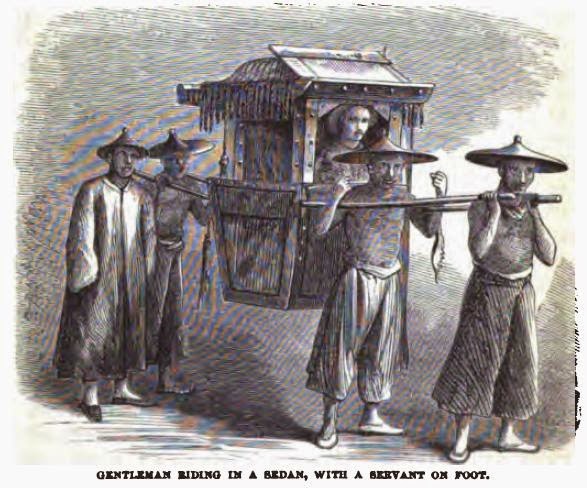
The public roads are all narrow - four feet wide - as if made for foot-passengers. If the emperor were to come from Pekin to Foo Chow, he must come by palanquin. The rivers are used as far as may be, and boats are generally drawn by men on the banks, by means of ropes. When they come to a rapid in the stream, they wait until forty or fifty have collected, when they join and draw the boats over, one by one.

In my evening walk on the day before New-Year’s I saw a fight. A young man knocked an old one down, and was beating him severely, when some coolies bearing a palanquin dropped their burden, seized the stronger combatant, and handled him roughly, saying, “You must not beat an old man.” His replay was, “He owes me. This is the last day of the year. If I do not collect my debt to-day it will be canceled.” New-Year’s is the only Sabbath of the Chinese. Then all business is suspended, all respectable people gather their families and friends for feasting, and the streets are abandoned to beggars and gamblers. The law against gambling is by custom suspended for twenty days after New Year’s, and during all this period groups of gamblers may be seen at every corner.

The hill-sides are generally cultivated wherever there are no graves, and in the valleys is luxuriant vegetation. The fields are cultivated, not mined. What we call agriculture is usually mining. We take all out of the soil and put nothing back, leaving it so much poorer than before as the crop is worth. Not so in China. The fields, which need no fences, so closely are they watched, are daily enriched by offal of the city, which is carried in buckets on the shoulders of men to be spread over their surface. The city needs no drains. All its garbage and offerings to Cloacina are sold and carried off day by day; but the stranger needs a handkerchief well perfumed to hold his nose in his evening walks afield.

The city is the capital of Fokien, one of the five ports thrown open to the British by the treaty of 1842, and contains seven hundred thousand inhabitants. It stands on a plain on both sides of the Min, but the old city is on the left bank, defended by a wall of ten miles circuit, thirty feet high and twelve thick, which has towers at short intervals, that look gay with flags and bear the marks of activity, as the city is threatened by a rebel force said to be very strong and intrenched near Swatow. The entrance is by seven gates commanded by towers. A bridge, four hundred and twenty paces long, resting on an island in the stream, and supported by forty-nine stout piers, crosses the river, and connects the two parts of the city. Foo Chow has fine residences for the civil and military authorities, and large granaries. It is celebrated for the manufacture of porcelain, and is said to contain hundreds of furnaces. It has also factories for cloth and cotton goods. Lead mines are near by, but its trade, which is supposed to amount to seven or eight millions, is its chief support. The streets are very narrow, not more than twelve feet from house to house. A fire having occurred in the main street, the Government ordered that it should be widened three feet. The stores are built of wood, and touch each other, so that if one in a block gives way the rest follow. A block of fifty houses fell down a few days since. The fronts are movable, so that there is no need of doors. When the shop is closed it presents to the street a wooden wall, and when it is opened this is taken down. The chief security against fire consists of large tanks of water in the street above ground. Another arrangement is a number of fire-proof walls by which the houses are separated. Usually, when a fire begins and can not be at once subdued, it is allowed to advance until it is arrested by one of these walls. The houses are low, and the roofs project over the street to form a protection against the sun, which almost shuts out its light.

There are numerous remarkable wells just outside the city wall, all more or less mineral, and some strong of sulphur. They differ very much in temperature, some being 104 degrees Fahrenheit; one 140 degrees. The Catholics say they first taught the Chinese the use of them. Bathhouses are constructed all around them. In these you may have an ordinary bath for four cents. You may also have refreshments to order. It is somewhat disgusting to a European to see the bathers going from their baths in a state of nudity to the refreshment apartment, and returning to the baths again after having partaken. The poor people bathe in the springs in the open air. A dozen may sometimes be seen in one spring. Their only expense is a cash or two, that is, a mill or two, which is given to the boys who watch their clothes. The waters are supposed to be especially valuable in cutaneous diseases, which are common in China.

The population of the city is not homogeneous. There is a Tartar garrison, where daily rations are distributed to two thousand soldiers. The population of the Tartar quarter is said to exceed twenty thousand. Besides soldiers and their families, there must be some engaged in other pursuits. There is a mosque in the city, quite inferior, however. The worshipers are chiefly Mongols, of whom there are about thirty families.

But it is time we took a particular look at our churches. Brother Gibson takes me in a chair to a chapel on the right side of the river, where services are held three times a week besides Sabbath. It is probably well located to catch strangers, but is a small, dirty, forbidding room, kept by an old man, whose son, as we entered, lay in the aisle unconscious, having taken too much opium, probably with a view to kill himself. The old man offered me his pipe filled and lighted, but on my declining he applied it to his own lips. It was in the shape of a cane, and of the same length. Returning we called at a large temple, which presented nothing elegant, either in architecture or decorations, and seemed to have a large space for a worshiping congregation. The gods are various and infamous, and incense was burning on every altar.

Another day we go to see a church in the city proper. Down successive flights of stone steps to a thronged street, along this - which runs parallel with the river - for some distance, then turning north, we cross the stone bridge to the island; through the island, which is thickly populated; then over another stone bridge to the city proper. After traveling some three miles through a crowd we reach the city wall, and pass through gates and massive arches to the interior. About a mile from the south gate of the city is our church, called East-Street Church. It is a plain, neat structure, with a parsonage in the rear, and stands on the spot where, a year ago, there was a mob which tore down the buildings we formerly occupied, and abused the women and children. After repeated applications for redress we got an indemnity sufficient to build our new house, but the Government was too weak to bring the offenders to justice. A native helper, one of the Hu family, lives in the parsonage. As soon as the doors were open for worship the people began to enter, one with a basket of live poultry, another with vegetables, another with a string of money, or cash, round his neck. They took seats, and some remained to the close; but many arose and departed after hearing a short time, their places, in some distances, being supplied by fresh comers, so that at the termination of the meeting we still had a good congregation. After a short prayer a sermon was delivered, and then I made an address, which the missionary interpreted. In the vestibule tea was prepared for the preachers. It is said that on any day, during business hours, you may have a crowd by opening the doors. Curiosity brings them in. One aged man, after service, asked for and received a copy of the Chinese Bible. On Sabbath, in the church on the mission compound, we had Chinese service in the morning. Yek Ing Kuang preached. He is one of our native helpers, and apparently a man of power, culture, and piety. After his discourse I addressed the assembly through an interpreter.

In the afternoon I preached in English. There were present, besides the members of our mission, some persons from the Presbyterian, and other Europeans, the American Consul, etc. Mrs. Baldwin played the melodeon. In the evening the missionaries assembled in Mr. Maclay’s parlor for prayer and sacred song, thus closing the holy day delightfully, and in a way to remind us of home, sweet home. During the next week I had the happiness to attend a monthly meeting of the missionaries, in which their bills are audited. These bills are for natives helpers and incidental charges. They are announced, explained, and, if no objection be made, allowed and recorded.

On February 1st I went with Mr. Sites to his residence, Ngu Kang. This is up the river some distance. For the purpose of communicating with the mission he hires a boat at $16 a month. The boatmen own it. Once the mission owned a boat, and these boatmen worked it. Some of the native Christians wished to manage it, and were of course preferred, but being unskillful they soon lost it. This boat resembles the flatboats of the Mississippi, and is remarkably neat. It is said that the boats in China are among the neatest things in it. Many of them, like this, are occupied by families. The head man of this boat lives in it. He has a wife and child, and the former takes her place at the oar with other rowers. We go part way by oars, then the boatmen get out and draw the boat by ropes, as a canal-boat. When the wind favors sails are used.

After landing we had a three-mile journey to reach the mission residence, which contains a chapel in the center. One each side is a little village, the one entirely Pagan, the other partly Christian. Our cause here gained rapidly for a time, but now the line is sharply drawn between the Pagan and the Christian community, and the opposing forces are hostile.

We next go to the Peach Farm, “To Cheng;” here there is a chapel. Near by is a large house, in which several Christians dwell. The houses of the peasantry are usually wooden, and of great length and uniform style. I was in several of their parlors or audience rooms. They were open-roofed, supported by large wooden columns, without any floor but the earth, and without any furniture but a table and some rude benches. In one I saw a plow and a rake, and in another a hen sitting in a basket. This region is mountainous, but here and there the valleys open into rich plains. In these wheat is growing, which I am told will be followed during the season by two crops of rice. On the hill-sides, on terraces, potatoes and many other vegetables are raised. An acre in the valley is said to be worth $300.

Before leaving Ngu Kang the Christians were assembled in their church; they represented five different classes. After the usual religious services brother Sites gave the people an opportunity of speaking, and interpreted their addresses to me. They abounded in thanks for my visit, prayers for my safe return, desires that I would ask the prayers of American Christians for China, and that Chinese Christians might stand fast in the Lord, and solicitations that I would bear these salutations to my country. Sia Sek Ong desires, above all thins, that the Bishop should ask the American Church to pray that Chinese Christians may be filled with the Spirit, and that converting power may come down upon the nation.

Li Moi Sing, a sister of sixty-four years old, prays that Christians on both sides of the globe may be one mind and heart. She has unutterable joy in Christ.

Li Anna, a sister seventy-four years old, says she has great peace in believing, thanks the grace of the Father and the Son that she meets a Bishop, and prays that he may safely reach his home on earth, and finally his home in heaven, where she expects to meet him again.

I closed the meeting with an address and prayer. In due time I returned to Foo Chow. Our land journey is performed in chairs; it is over a path concerning which there are many legends of robbers in the olden time. Our voyage down the river is nine miles, and we make but three miles an hour, as the tide is against us.

Next day I visited Miss Woolston’s school. The furniture is plain, rough, and cheap, but clean; the children are plainly but neatly dressed. There are benches for chairs, mattresses for beds, and bamboo frames for pillows. All this is that they may not be discontented on returning home. Misses Woolston are much encouraged by accessions recently received. There are now twenty-three girls under instruction.

One of the first objects of my attention was Mr. Gibson’s school, the scholars of which, thirteen in number, had been dismissed for the New Year’s holidays. The boys are generally Christians.

One day we had in our city church a sort of reception. All our members were collected, with the members of other missions and all the missionaries of the American Board, except Mr. Baldwin, who was sick. After singing and prayer, and reading the Scriptures, I made an address, or sermon, brother Maclay interpreting. Then the brethren spoke voluntarily, each delivering a short address. They spoke with remarkable readiness, earnestness, and grace. Their words were reported to me and translated by the superintendent, but they are too voluminous to be inserted here. They were full of gratitude to the American Church, of compliments to her representative, and prayers for God’s cause in both America and China, and for the universal coming of Christ’s kingdom.

On the succeeding Sabbath we had quarterly-meeting in the church on the mission compound - Tien Ang Tong. Brother Gibson held a love-feast at half-past nine, A. M., which continued till near twelve. Tea and cake were distributed instead of bread and water. Brother G. alluded to his departure, and intimated that it might be his last service. Mr. Baldwin favored me with an abstract of the speaking. Dr. Maclay preached at twelve on the Eighth Commandment, one of a series on the Decalogue. He writes his discourses, but studies them well. At two o’clock I preached in the same church to an English congregation.

My next visit was to the church under the care of Mr. Baldwin - Ching Sing Tong. It is a substantial brick building. In the vestry we found Hu Sing Mi, who visited the United States in company with Dr. Wentworth, and found a home for two years in the family of J. Stephenson, Esq., New York City. His room contained many conveniences; such as, cooking stove, iron bedstead, and bedding, of American manufacture, all, I understand, presented to him by his kind benefactor in America. Also, portraits of Messrs. Stephenson, Odell, and other well-known faces. A local preacher - Tang Ien Kong - lives in the parsonage adjoining the church. The bell having been rung, the people came in from the street and took seats, not so many as usual, in consequence of New-Year’s. The local preacher preached. I followed with a brief address, which seemed to interest them. Mr. Baldwin interpreted for me.

CONTROVERSY

Harmony prevails among the mission with the exception of a dispute about certain terms.

Two hundred years ago a controversy arose in the Roman Catholic Church in China concerning the proper name for God; the Jesuits using the term Shangti, the Dominicans Shin. The matter was referred to the Pope, who compromised by adopting a new term, Teen Chu, Heavenly Lord. The first Protestant missionaries used Shin for God and Hung for Spirit. Dr. Medhurst advocated the use of Shangti for God and Shin for Spirit. About the year 1846 those who used Shin for God adopted Ling for Spirit. The Protestant missionaries are now divided into two parties, about equal in number. In 1847 the missions in Foo Chow adopted Shin and Hung, often using Shangti as an appellative; subsequently they adopted Shin and Ling. This continued until 1860. About this time the Church of England used Shangti and Shin, and in the following year all the missionaries of the American Board here adopted the same terms. In August, 1865, a majority of our mission being in favor of them, waived their preference, and adopted, on Mr. Gibson’s motion, the following, after some months of consideration:

“WHEREAS, The members of this mission are divided in opinion as to the best terms to be used in China for God and Spirit, and also with reference to the best version of the Scriptures in Chinese; therefore,
“Resolved, That the several members of the mission, and the native helpers in our employ, should, for the present, use the Chinese terms they severally prefer for God and the Spirit, and also the version of the Scriptures which they deem best.”

At that time the mission stood, three for Shangti and Shin, two for Shin and Ling. Among the Protestant missionaries of Foo Chow the vote stood, eight in favor of Shangti and Shin, two in favor of Shin and Ling. Our native helpers stood, eight in favor of Shangti and Shin, one in favor of Shin and Ling. All the native helpers of other missions were in favor of Shangti and Shin. There was a prospect that under this compromise resolution harmony might be secured; but it seems that the minority, as they studied the question, found it magnifying in importance, ceasing to be a philological question, and becoming a moral one. Not content with the liberty to use the terms they preferred, they felt bound to contend with those who used others. One would not allow his native helpers to use them, withdrew his members from the monthly concert, and kept his scholars from our public meetings. Two refused to circulate the version of the Scriptures preferred by the mission - distributing that of Drs. Bridgman and Culbertson - and all books in which the objectionable terms occur, and could not allow to be sung in their churches the hymns in which they are employed. One of these has returned, and other remains; but, no doubt, time will cure the discord. I must confess that after hearing the whole question discussed, I could but look upon the difference as of but little consequence, though the controversy may be very evil in its results if it should be continued.

OTHER MISSIONS

There are in Foo Chow the following missions besides our own: 1. The missions of the American Board. They have four missionaries, with their wives; namely, L. B. Peet, C. C. Baldwin, Charles Hartwell, and S. F. Woodin. The Church of England Mission has two missionaries, with their wives; namely, J. R. Wolfe and A. W. Cribb. The premises of the American Board are partly withn and partly without the city wall.

Calling upon the missionaries of the American Board, I found they had just purchased an eligible piece of property for $3,400. On one occasion I dined with Mr. Baldwin - whose wife has an interesting school, to which she seems devoted - and on another occasion with Mr. Peet. I also called upon Mr. Wolfe, Church Missionary, by whom I was kindly received. His house is on an eminence commanding a fine view of the city, in which stand prominently both the Catholic and Episcopal churches, substantial, ornamental, and admirably located. The former is very large, and its architecture, arrangements, and ornaments are all in Chinese taste. It has a garden and a nunnery attached to it, and a foundling hospital opposite. It claims to have three thousand members.

The missionaries of the different Protestant missions come together in a monthly concert of prayer. I led the meeting on one of these occasions, opening it with an address. These brethren seem to regard each other as members of one body, and work together in harmony.

The following sources of encouragement may be noted: 1. The decline of prejudices against foreigners and against the Gospel; 2. The removal of all legal obstructions to the spread of Christianity among the people, and to its propagation throughout the country; 3. A steady increase of the influence of Christian nations in China; 4. Legal protection for both native and foreign Christians; 5. The readiness of the people to receive missionaries, and the invitations from them in various parts; 6. Proofs of conversion and the power of the Gospel in the lives of Chinese Christians; 7. Gifts, graces, and usefulness of our native helpers. They are well-formed, well-dressed, noble-looking men. One of them, of the celebrated family of Hu, told me he was stationed one hundred miles off, in a sickly place. Sometimes he gets he ague and comes back to recruit, but is soon at his post again.

BUDDHIST MONASTERY

Before leaving Foo Chow I went to the celebrated Buddhist monastery at Kushan Mountain. We descend the river in the mission boat about six miles. Then landing, we take a chair and ascend the mountain, up which a broad stone pavement leads all the way to the monastery. There are rest-houses on the way, where refreshments may be obtained. The mountain is rocky and sterile, though a few pine-trees are making slow progress here and there, where the soil allows them to take root. The views of the river, and city, and surrounding country from the different rest-houses are charming. As we approach the monastery we see a number of disabled cattle, which are in charge of a herdsman, and which, it is said, are preserved from death and suffering by the monks, who deem it a high virtue to preserve life. There are springs near the monastery, and the water is received in a large tank, which seems filled with fishes. The building is in a very concealed but romantic spot. Though only one story, it covers a large space. The images at the entrance are colossal. We were just in time to see the monks assemble for worship; they are said to be seventy in number. They are of various ages; all have their heads shaved, are clad in yellow robes, and look melancholy. The worship consists of genuflections, recitations from their sacred books in Pali, which few, if any, understand, singing, etc. The exercises are regulated by bells, though time is kept by beat of drum. In passing through the library a priest politely insisted on our taking tea, and heartily rejected money that was offered for it. A short time since there was a devotee locked up in a cell for meditation and purification, but having served out the time of his vow he had passed out.

The camphor-tree spreads its ample shadows over this sacred spot, and the tea-plant grows on the hills around. The location is so cool and healthful that our brethren resort to it as a sanitarium. They have a contract with the monks, by which certain rooms shall always be ready for them at a dollar a week each. The missionaries furnish them, and provide their own meals; but how revolting to take a family to such a place, making them familiar with the forms of idolatry! It is like hiring a spot in the suburbs of hell in which to pass the cold weather.

EXPERIENCE OF NATIVE HELPERS

My coming to Foo Chow excited much curiosity and conversation, not merely among the missions but beyond. My visit and my relations became generally known through the members of the Church and the servants of the households of the missionaries. As I was passing, with brother Maclay, a group of heathen Chinese, one of them said, “There goes the Bishop. He is like Jesus Christ; he goes round the world preaching the Gospel.” This shows that the common people know something of Christ, and the nature and scope of his religion.

Before I departed the missionaries assembled, and delivered to me in writing a grateful and affectionate address, signed by all their number, to which I replied as best I could. The chief members of the mission favored me with their autographs, and preceded them with remarks which the superintendent translated. The substance of some of these remarks I give. Yek Ing Kuang says: “Entering the Christian Church I had two thoughts; namely, Christ died for me and for the sins of the world. My nation is given up to idolatry. Your face is as the face of an angel. Pray for me.”

Hu Po Mi said: “I rejoice in your visit to Foo Chow, because it is a proof that the Western nations are constrained by the love of Christ to love us who live in the East. Before seeing your face I seemed to be with you in the Gospel. Ten thousand thanks to you and the Churches of America.”

Li Ju Mi says: “My heart rejoices when I read, ‘He that believeth shall be saved,’ and sorrows when I read, ‘He that believeth not shall be damned.’ I have seen believers enjoy great peace and die in the Lord. We are three brothers, but the youngest, King Sing, twenty-four years old, died last year, ninth moon, twenty-seventh day. He had great peace, and in departing said, ‘My sins are great, but my Savior is sufficient. To go home is better than to stay. Be diligent in preaching, for Christ only can save.’”

Sia Sek Ong, native exhorter, said: “Thanks to the Heavenly for the joy of seeing your face. Pen can not record the fullness of grace I have in my inmost soul. May you return in safety, and cease not to pray that God may pour out his Holy Spirit upon us that China may be saved!”

Tiong Tai Hung says: “I believing in Jesus. Neither is there salvation in any other.”

Hu Hieng Mi says: “As to my entering the Church, see John v, 24; viii, 51; iii, 18.”

Tiong Keng Chung says: “A great blessing to observe the love which the Bishop has shown in leaving his country, home, and kindred, to endure the sufferings of a long voyage, and meet the perils of travel in strange lands, to encourage feeble Christians in trying to serve God. I thank him for his exhortation to filial piety and brotherly love. My salutations to the Christian Churches of America.”

Lai Tai Sing says: “Seeing the Bishop, and hearing his words, I rejoice. Salutations to the Churches in the United States. From you we have received the Gospel missionaries, who crossed the ocean to preach the Word of Life and establish Christian schools. In Mr. Gibson’s school I received instructions, and the Holy Spirit opened my heart to receive the Savior. Pray that I may be a useful disciple.”

Le Sing Mi says: “Joy and gladness that I behold thee. Thou hast received the love of Christ to bear thee oceans to meet here the disciples of the Lord. God grant thee great peace of soul in returning to thine own house! Greet the elders and the brethren for me.”

Ting Ka Chung and son say: “Coming to Ngu Kang, and seeing the face of the Bishop, my soul is filled with joy. The Heavenly Father hath brought thee to China to encourage his holy Church.”

The Koi Hung class of fourteen members write: “Through the grace of the Savior we see you. God grant you grace and a peaceful return! Greet the American Church, and pray for China.”

Tang Yeu Keong says: “When I beheld the Bishop’s face my great greatly rejoiced. When I saw his feebleness, and considered that it was for Christ’s sake he suffered, that he might cross the wide oceans to come for God’s people, and that he did not fear the discomforts and dangers of the voyage, only desiring to aid the few sheep in these ends of the earth, truly, my heart is lost in wonder and love. I thus know you to be a genuine Bishop. See John x, 11. Your visit and your example will be a great blessing to us all. May God abundantly bless you, and bring you to the end of your voyage in peace!”

Nu Sin Mi says: “Through God’s grace I know to travel in the way to heaven. In my heart I love you with the love of Christ. God grant you a prosperous voyage! Though parted from you in body, we shall still pray for you and your family, and the whole Church of God in America. We heartily thank you all for sending us the Gospel and a messenger to strengthen us in the faith of Christ.”

Sing Ching Ting writes: “My salutations. With regard to my sins, see 1 Tim. I, 15. As to my darkness, see Matt. iv, 16. As to my light, see 1 John iv, 10; John iii, 16; Romans viii, 32. As to Christian love, it is shown in the labors and sufferings of the missionaries and their Bishop, enabling us who were dead to live in Christ. Now, seeing the Bishop’s face, we rejoice with exceeding joy. I love the Bishop, the missionaries, with their wives and children, as my own brothers and sisters. China is given up to idolatry. Pray for us! Grace, mercy, and peace be with you all!”

Hu Yong Mi writes: “Peace and myriads of blessings upon the Bishop! Thanks to God, who hath given you a prosperous journey. Seeing your face reminds me of the joy of Joseph when he beheld the face of his father, Jacob; but I am unworthy of the comparison. Forgive this boldness. Unceasing thanks to the Triune God, who hath saved sinners. The joy is unspeakable. Your eye hath seen the fellowship of saints. You have not shrunk from peril that you might increase our knowledge and joy. Having received such favor, I beg you accept the thanks of one less than the least of all saints. May God evermore be merciful to you! You have told us to bear the cross. My soul answers, ‘Thy cross, Lord, will I bear.’ We send out the Macedonian cry. Pray for us. Paul desired the Thessalonians to pray for him. Be pleased, also, to convey our salutations to the bishops, pastors, and members of the Church in the United States.”

I make the quotations without embarrassment, because, though they are no compliment to me personally, they show the feeling of our Chinese brethren toward the Church at home.

(Taken from Edward Thomson’s Our Oriental Missions, published in 1870. Thomson was the Bishop of the American Methodist Episcopal Church in the 1860s.)

Sep 7, 2014

Social life of the Chinese


Fuhchau, as the name of the city is known among foreigners, being according to the Mandarin pronunciation; Hok-chiu, as known to its inhabitants, according to the local pronunciation - the “Happy Region” - is the capital of the province of Fuh-kien. It is situated about thirty-five miles from the month of the River Min, and two and a half miles from its northern bank, in a valley fifteen miles in diameter from north to south. Its longitude is 119°20′East, and latitude 260°05′North, a little farther south than the most southern point of Florida. Of the five ports opened to foreign trade and residence at the close of the Opium War, by treaties made in 1842-’44 between China and England, France, and the United States, Fuhchau occupies the central position, being situated between Amoy on the south and Ningpo on the north, and about equally distant from Canton and Shanghai.

Fuhchau is a walled city, having seven massive gates, which are shut at nightfall and opened at daybreak. Over each of the gates are high towers, overlooking and commanding the approach to them. At intervals on the walls are built small guard-houses. The walls are from twenty to twenty-five feet high, and from twelve to twenty feet wide, composed of earth and stones. The inner and outer surfaces are faced with stone or brick, and the top is paved with granite flag-stones. The circuit of the walls is about seven miles, and can be traversed on the top on foot, or in sedan-chairs, a1fording a variety of novel and interesting views in quick succession. Outside of each gate are suburbs. The southern suburb, known to the Chinese under the general name of Nantai, extends southward toward Amoy nearly four miles. Outside of the east, west, and southwestern gates there are also extensive suburbs. The suburbs outside of the three most northern gates, two of which lie on the eastern side of the city, are far less extensive and important than the other four.

The population of the city and suburbs bas never been accurately, and therefore satisfactorily ascertained. The inhabitants of the seven suburbs are believed to be as numerous as the inhabitants of the city itself. The population of both has been estimated by residents and visitors at all figures, from 600,000 to 1,250,000. Including the people dwelling in boats, who are quite numerous, it probably would not be far out of the way to say that the population amounts to 1,000,000. A few years ago it was reported at Fuhchau that a certain mandarin had informed the English consul that the people within the city walls numbered 500,000.

Like Canton, Fuhchau is a city of the first rank, being not only the capital of Fuh-kien province and the residence of its governor, but also the official and actual residence of a viceroy, or governor general, whose jurisdiction extends over Fuh-kien and Chekiang, its adjacent northern province. The word fu, sometimes affixed to its name, as Fuhchau-fu, indicates that it is the chief city of a prefecture or department, and, so considered, it has the same rank as Ningpo. It is also the residence of two district magistrates, the boundary-line of whose districts passes through the city from north to south. Besides, it is the residence of a large number of civil and military officers of high grade. Among them are the Tartar general, who is of the same rank as the viceroy, the provincial criminal judge, the provincial treasurer, the commissioners of the salt and the provision departments for the whole province, and the literary chancellor. It is the political, literary, and commercial centre of a province, whose area is over 68,000 square miles, and whose population, according to the census taken in 1812, was then more than 14,600,000. A census taken in 1842 makes its population over 26,000,000. There are always at this city a large number of expectants of office of high grade awaiting their actual appointments. Numerous gentry reside here, who have retired from office in other parts of the empire.

It is a great literary centre, not limply because it is the official residence of the imperial commissioner, the literary chancellor, but because there are many men living here of high literary attainments in a Chinese sense, and also because all of the literary graduates of the first degree over the province of Fub-kien, which includes the large island of Formosa, must appear at Fuhchau twice every five years to compete in the provincial examination hall for the second degree, if they desire to compete for that degree at all. Usually six or eight thousand of the educated talent of the whole province assemble here on these interesting and exciting occasions.

Legitimate foreign trade at Fuhchau was insignificant until 1853. The opium trade had been extensively carried on for several years previous to that period by means of receiving ships stationed near the mouth of the Min. In 1853, Fuhchau came suddenly into importance as a market for black teas, mainly through the enterprise of Messrs Russell & Co., an American firm. Previous to this year no teas were shipped directly from this port to any foreign country. In the spring of that year the American firm mentioned sent from Shanghai their Chinese agents into the tea districts lying near the western and northwestern borders of this province, and bought up large quantities of tea, and had it transported in small boats down the River Min to this city. By the time it was ready for shipment foreign vessels arrived, according to agreement, and took the tea direct to foreign countries. In that year fourteen foreign vessels arrived at Fuhchau, and in 1858 one hundred and forty-eight vessels.

A few statistics will show the rapid growth of the tea trade at this place. The exports of tea to foreign countries in the year 1856-’57, from April 30th, from Canton, was 21,359,885 lbs.; from Shanghai, 36,919,064 lbs.; and from Fuhchau, 34,019,000 lbs.; and that only three years after the trade was commenced at the latter port. During the tea season, beginning with July, 1859, the exports of tea from Canton to the Unite States amounted to 3,558,424 lbs.; from Amoy, 5,265,100 lbs.; from Shanghai, 6,893,900 lbs.; and from Fuhchau, 11,293.600 lbs.; the quantity sent from Fuhchau being nearly one million pounds more than the combined amount sent from Canton and Shanghai. During the same period Canton sent to Great Britain 41,586,000 lbs.; Shanghai sent 12,331,000 lbs.; Fuhchau sent 36,085,000 lbs., or about two thirds as much as both Shanghai and Canton. In the tea season, 1863-’64, ending with May 31st, Fuhchau sent to Great Britain 43,500,000 lbs.; to Australia, 8,300,000 lbs.; and to the United States, 7,000,000 lbs.; in all amounting to more than fifty-eight millions of pounds. From these data the relative commercial importance of Fuhchau is easily seen. It has become by rapid strides one of the most important of the consular ports in China for the purchase of black teas. It was currently reported in 1850-’51 that the English government seriously contemplated giving it up, or at least exchanging it for some other port whenever an opportunity should occur, because it had no commercial importance.

In exchange for its tea, which is the principal export from Fuhchau, to foreign countries, it receives opium, cotton and woolen goods, si1ver, and a few unimportant articles. In the year ending December 31st, 1863, the imports into Fuhchau from foreign lands amounted to over ten and a half millions of dollars. Of this sum, the value of the opium imported was over five millions. Unlike Shanghai and Canton, it furnishes no silk for exportation.

It has a large trade with other ports on the sea-coast by means of native craft, as well as in foreign vessels, giving and receiving some of the other luxuries and the necessaries of life. Frequently rice is imported in large quantities from Formosa and from Siam. An immense amount of timber and paper is brought down the Min from the upper or western portions of the province, and taken to various ports north and south. It annually exports large quantities of dried and preserved fruits. Twelve and fifteen years ago, not unfrequently there were several hundred Chinese junks in the harbor at the same time, discharging and receiving cargo. Of late years, many Chinese merchants charter foreign ships to carry away and bring back produce and merchandise, on account of their increased speed and safety compared with Chinese crafts. Native junks almost always come up the river and anchor opposite the city.

While the high native officials, civil and military, live within the city, the foreign consuls, vice- consuls, and interpreters reside two and a half miles outside the city, on the hill near the south bank of the Min. No foreign merchant lives in the city, nor is there any foreign hong or store inside the walls. The principal native wholesale merchants do their business in the immense suburbs surrounding the Great Temple Hill. The principal native banks are also in the southern suburbs.

A part of the eastern and southern sections of the city is devoted, though not exclusively, to the residence of Manchu Tartars. They are subject, not to Chinese, but to Tartar officers. There is no wall dividing them from the Chinese, as has been sometimes represented. A few Chinese live scattered about in the sections originally given op to the Tartar population. The Manchus number at present probably between ten and fifteen thousand. All of the males professedly belong to the army, though the number of those who actually receive pay in money, and rations in rice monthly, as soldiers, is said to be limited to one thousand. When any of their number dies, another Tartar takes his place on the roll of soldiers, and succeeds to his salary and perquisites. These soldiers are not called away from Fuhchau to serve in the army, but remain at home, assisting when called upon to guard and keep the city. They spend their time principally in the practice of archery, horsemanship, and shooting at a mark with matchlock guns. Until late years none of them engaged in any business for the sake of gain. But poverty has driven a few to open shops, where some of the commonest articles are offered for sale. They generally speak among themselves the Mandarin or court dialect, though some understand the Manchu language. Most or all are able to speak the colloquial dialect. They are not noted for their knowledge of Chinese literature. Within a few years, more have applied themselves to the study of Chinese books than formerly. As a class, they are indolent, ignorant, and proud.

They have the reputation of being overbearing and insolent toward the Chinese – a natural and almost inevitable consequence of their relative positions. They are the masters and the lords; the Chinese are subjects. The Manchu and the Chinese men shave their heads and braid their cues alike; the former having obliged the latter nearly two hundred years ago to adopt the Manchurian national costume of dressing their hair. The Manchu ladies do not compress their feet as do the upper class of Chinese ladies at this place, and in this respect compare favorably with them. They are of a large frame, more noble in appearance, and more independent in action, than are the Chinese females. The same remark is true of the Manchu men compared with the Chinese men. The two races are not allowed to intermarry.

The Tartars here are descendants of a colony of Tartars who came from Peking by the will of the emperor in the early part of the present dynasty. They regard themselves as distantly related to the imperial family, and all owe their support to the favor of the government. They may be always relied upon by the Peking government as faithful to it under all circumstances. In the result of a successful rebellion against the government, in case they should not be able to make their escape to the land of their forefathers, an extremely doubtful event, they would all lose not only their salaries and their property, but also their heads; for no successful rebel emperor would allow any of the Tartars to live in the country.

Foreign vessel of large tonnage anchor about ten miles below the city of Fuhchau, at Pagoda Anchorage, so called on account of a pagoda built on a hill on an island in the vicinity. Above that anchorage the water is too shallow for large vessels to endeavor to proceed with safety. Here the mail steamers, which arrive usually at least once in two weeks, come to anchor, sending the mails up to town in a small but well-manned boat. Not unfrequently are there twenty-five or thirty sailing vessels and steamers of several different nationalities to be found at Pagoda Anchorage, discharging and receiving their cargoes, where thirteen years ago there was not one foreign vessel. The vessels lie in the middle of the Min, and their cargoes are transferred into lighters, which ply between the town and the anchorage.

The entrance to the river is marked by bold peaks and high land – unlike the entrance to the Yang-tse-Kiang, en route to Shanghai from the China Sea, or the entrance of the White River at Taku, en route to Tientsin and Peking from the Gulf of Pechele. Foreign pilots usually take the charge of vessels until they have fairly entered the river, when they yield to native pilots, who navigate them until they reach Pagoda Anchorage. The banks of the Min are lined by lofty hills, generally destitute of thrifty trees. Many of the hills are terraced and cultivated to their tops, presenting in the spring and summer an interesting and unique appearance. The foreign visitor never fails to admire the charming and romantic scenery lying between the mouth of the Min and the anchorage. It has been thought by some European travelers to resemble the scenery of Switzerland in its picturesqueness and grandeur. Americans are more frequently reminded by it of the Highlands of the Hudson.

The Min having separated into two parts six or eight miles above Fuhchau, the branches unite not far above the anchorage, and their waters tow together into the ocean. The city of Fuhchau lies to the north of the northern branch. The southern branch passes nearly parallel with the northern, the two forming a narrow and fertile island, fifteen or sixteen miles in length, and three or four miles in width in its broadest part.

Following up the northern branch of the river from the Pagoda Anchorage, about half way to Fuhchau, on the right hand, is the mountain called Kushan, or Drum Mountain. Its peak is about half a mile high. A large and celebrated Buddhist monastery is situated half way op the mountain, a favorite place of resort with some foreigners and Chinese in the hot summer months. The temperature at the monastery is sometimes eight or ten degrees lower than in the city in the valley below. The monastery takes its name, the “Bubbling Fountain,” from a spring of clear cold water in its vicinity. Several score of Buddhist priests are usually found at the monastery, where they spend their time in studying the rituals of their order, and in the performance of the regular religious l rites and ceremonies. The landscape of the valley of the Min, viewed on a clear summer’s day from the top of the mountain or from its side, is very fine, consisting of numerous small streams and canals funning in all directions, several scores of hamlets dotting the country, and rice-fields in a high state of cultivation. These, once seen, are not soon forgotten.

Soon after passing Kushan, proceeding up the river, two lofty pagodas become visible, three or four miles distant, situated on the right hand, and inside the city, near the southern gate. A lofty watch-tower marks the extreme northern angle of the city. The foreign bongs and the flag-staffs of the English, American, and other consuls, gradually become more and more distinct, lying principally on the left band, on the southern bank of the Min. The hongs and residences of foreign merchants, missionaries, and officials, being built in foreign style, afford a pleasing and striking contrast to the shops and houses of the Chinese. From some parts of the river opposite the city, the brick chapel belonging to the Methodist Mission, and the stone church where a chaplain of the Church of England officiates, both located on the hill near the southem bank of the river, can be readily recognized by their belfries.

In the Min, abreast of the city, is a small, densely-populated island, caned Chung Chau by foreign merchants, and Tong Chiu by the natives, i.e., “Middle Island.” It is connected with the northern bank of the river by the celebrated “Bridge of 10,000 Ages,” or the Big Bridge. This bridge is reported to have been built eight hundred years ago, and is about one quarter of a mile long, and thirteen or fourteen feet wide. It has nearly forty solid buttresses, situated at unequal distances from each other, shaped like a wedge at the upper and lower ends, and built of hewn granite. Immense stones, some of them nearly three feet square, and forty-five feet long, extend from buttress to buttress, acting as sleepers. Above these stone sleepers a granite platform is made. On the sides of the bridge are strong stone railings, the stone rails being morticed into large stone pillars or posts. Until eight or nine years ago the top of the bridge was partly taken up with shops. Now the whole of the bridge is devoted to the use of passengers, and the conveyance of merchandise to and fro. The bridge connecting Middle Island with the south bank of the river, called the “Bridge in front of the (salt) Granaries,” is built in a similar manner, but is only about one fourth as long as the Big Bridge. Lighters and other boats which have movable masts pass under the Big Bridge, but the junks from Ningpo, Amoy, and other places, which come up the river, anchor below these bridges and Middle Island. There are no ferry-boats which ply regularly between the north and south banks of the Min, though there are numerous boats which can be hired for a few cents whenever necessary to cross the river above and below the bridges. From early dawn until nightfall these bridges are usually thronged by travelers on foot or in sedans, and by coolies carrying produce and merchandise back and forth.

To the northwest, and distant six or seven miles across the Min, is another celebrated tone bridge, called sometimes the “Bridge of the Cloudy Hills.” That and the Big Bridge are built, in a similar manner. The scenery in its vicinity is mountainous and interesting.


The foreign residents live principally on the hill near the southern bank of the Min. Standing on that hill, and looking toward the east, north, and west, the scenery is beautiful. To the eastward, looming up five or six miles distant, is “Drum Mountain.” Nearer is the river, with its multitude of junks and boats. As one glances in a more northern direction, parts of the city come within range. In it the white pagoda and the watch-tower are prominent objects. Between the city and the river, apparently about midway, may be seen the roof and belfry of a brick church belonging to the Mission of the American Board. In the city Black Rock Hill is conspicuous, and nearer, in the suburbs, are seen Great Temple Hill and several spacious foreign hongs. To the northwest and the west the numerous boats on the river and the distant hills present a diversified and striking appearance.

From the top of the Great Temple Hill, looking toward the south, the prospect is also fine. Probably there is not a better stand-point in the suburbs than that hill for taking a view of the most prominent objects to be seen in the valley of the Min. The river, spread out to the west, south, and east, covered with its countless boats, the bridges on each side of Middle Island, with their passing throng, foreign hongs, the British consulate, flag-staffs and tags of various nationalities, etc., always interest the beholder. In the distance to the southward, the hills called the Five Tigers, and other ranges, add variety and picturesqueness to the scenery. To the east and to the west are highly-cultivated plains, villages, canals, etc. On the north the city is seen much more distinctly than from the hill on the southern bank of the river.

Fuhchau contains within its walls three principal hills, two in its southern and one in its northern quarter. On account of these hills it is sometimes called in writing and in books the Three Hills. It is also frequently styled the City of Banian, or the Banian City, on account of the great number of mock banian-trees which are growing every where in the city and vicinity. The branches of this species of banian seldom extend to the ground and take root, like the Indian banian, though they sometimes thus take root. The pendent branches look so much like whiskers that the common name for them among the Chinese is the whiskers of the banian. They hang down several feet from the main horizontal branches, and swing back and forth in the breeze. A single tree with its outstretched branches sometimes shades a space of ground from one hundred to one hundred and fifty, feet in diameter.


The streets of the suburbs and the city are narrow and filthy. They oftentimes are not as wide as a medium-sized side-walk in cities in Western lands. Some of the principal streets in places are so narrow that two sedans can not pass each other. One must seek a wide spot and stop while the other passes along. Shop-keepers are in the practice of taking up part of the street in front of their establishments with their movable sign-boards, which are over a foot wide, placed in perpendicular position, making the street actually allotted to the public so much the narrower. The eaves of the stores and native hongs are so arranged that, in case of rain, the water falls down into the middle of the street. There are no eave-troughs in use. It is impossible in a hard shower for one to pass through the streets, even with an umbrella, and escape a thorough wetting.

There are no glass windows in the fronts or sides of shops and stores in Fuhchau. The front part of stores, etc., is constructed of upright movable boards fitted into grooves in two pieces of timber, one fastened on or near the door-sill, and one put at the top of the front of the room. These boards are numbered, and may be taken down and put up again expeditiously. At night they are slipped into the grooves, and fastened securely on the inside. In the morning they are taken down, letting the passer-by see all that is transacted in the store, and furnishing all the light that is needed. In storms the wind oftentimes blows the rain into the establishment; in cold weather the clerks and customers are exposed to chilling draughts of wind. Usually the whole front sides of the shops, facing the street, except a passage-way to the back, is occupied by a counter about four feet high.

The streets are paved with granite tag-stones. In case of a hill occurring in the street, it is ascended and descended by means of a tight of stone steps. On this account, even if the streets were wide enough, no wheeled vehicle could be used in them. Merchandise, furniture, etc., are carried to and fro through the streets by coolies. If the load is about a hundred pounds’ weight, or less, and can be divided into two equal parts, not too bulky, each part is slung by means of ropes on the ends of a carrying-pole, four or five feet long, which is placed across the shoulder of the coolie. It is thus carried to its destination, one part coming before and the other part coming behind the bearer. It can not be carried crosswise or at right angles to the street, for that coarse would prevent oftentimes any one passing from an opposite direction; it would generally occupy nearly all the street. Bulky and heavy articles, too bulky and too heavy to be thus carried by one man, are slung upon the centre of a strong carrying-pole, six or more feet in length. The ends of the pole are placed upon the shoulders of two or more men, and the load carried between them. Sometimes eight, or sixteen, or a greater number of persons are required to carry heavy articles in this manner. Occasionally a load is carried on the shoulder or the back, steadied by the hands of its bearer.

The roads in the country are narrow, and not adapted to traveling or transporting merchandise in carts or wagons. Oftentimes they are paved with granite, and only wide enough for two to walk abreast with ease and safety. Every five or ten Ii, on the most traveled roads, there are rest-houses, where the tired traveler or coolie may stop and refresh himself. There are no toll-gates in this section of the empire.

Traveling on land is performed on foot or by sedan-chairs, carried, in the case of a civilian, by two or three men. Officers of a certain grade may have four bearers. Those of the highest rank may have eight bearers. Military officers of a low rank, and a class of interpreters or assistants of high civil mandarins, sometimes ride through the streets on ponies, but the common people never ride on horseback. In case a horse is rode through the crowded streets, a boy or the groom precedes, crying out “Horse!” “horse !” and clears the way, else various accidents would often occur.


The hills in the vicinity of the city and suburbs of Fuhchau are devoted principally to burying the dead, the valleys and the level land to the residences of the living. While foreigners prefer to reside in elevated and airy positions, as on the sides or the summits of hills, the Chinese reserve these situations for the sepulchres of their honored dead. The graves of the poor Chinese are made much at random on the hills, on spots where they succeed in securing the privilege of digging them; while the sites for the graves of the wealthy are determined by the nice rules of the art of Geomancy, à la Chinois, having especial reference to the future good fortunes of the families of the living. No dead body may be buried inside the city, nor may a corpse be carried into any of the gates of the city. It may not enter the city on any consideration, no matter how high the rank of the deceased, or how influential and respected his family. The most fashionable form for a grave and its surroundings, considered as a whole, is what by foreigners is usually called the horse-shoe pattern, from its general resemblance to a horse-shoe. It is also called sometimes the Omega grave, from its resemblance to the Greek letter Omega. The rich spend a large sum of money in erecting the grave-stones, and in embellishing the sides and the front of the grave. In the case of high officers, there are often large granite images of a pair of horses, sheep, and other animals, arranged some distance in front of the spot on which the corpse is buried. One of each kind of animal is placed on the right and left hand sides, corresponding to each other. Occasionally there are two granite images or statues of men, arranged in like manner. These granite images, some of which are larger than life, seem to take the place of pillars and monuments, so common at the West, in connection with the tombs of the distinguished dead.

The first Protestant Mission at Fuhchau was established by a missionary of the American Board of Commissioners for Foreign Missions in January, 1847. The Mission has averaged three or four families since its commencement. In April, 1856, occurred the first baptism of a Chinaman at this city in connection with Protestant Missions. In May, 1857, a brick church, called the “Church of the Savior,” built on the main street in the southern suburbs, and about one mile from the Big Bridge, was dedicated to the worship of God. Its first native church, consisting of four members, was organized in October of the same year. In May, 1863, a church of seven members was formed at Chang-loh, distant seventeen miles from the city. In June of the same year a church of nine members was organized in the city of Fuhchau, having been dismissed from the church in the suburbs to form the church in the city. For the first ten years of this Mission’s existence only one was baptized. During the next five years twenty-two members were received into the first church formed. During the next two years twenty-three persons were baptized. Between 1853 and 1858 a small boarding-school, i.e., a school where the pupils were boarded, clothed, and educated at the expense of the Mission, was sustained in this Mission. Among the pupils were four or five young men, who are now employed as native helpers, and three girls, all of whom became church members, and two of whom are wives of two of the native helpers. There are at present a training-school for native helpers, and a small boarding-school for boys, and a small boarding-school for girls connected with the Mission. It employs six or seven native helpers, and three or four country stations are occupied by it. Part of the members of this Mission live at Ponasang, not far from the Church of the Savior, and part live in the city, on a hill not far from the White Pagoda, in houses built and owned by the American Board.

The Mission of the Methodist Episcopal Church was established in the fall of 1847. It has had an average number of four or five families. In 1857 it baptized the first convert in connection with its labors. In August, 1856, a brick church, called the “Church of the True God,” the first substantial church building erected at Fuhchau by Protestant Missions, was dedicated to the worship of God. It is located near Tating, on the main street, in the southern suburbs, about two thirds the way between the Big Bridge and the city. In the winter of the same year another brick church, located on the hill in the suburbs on the south bank of the Min, was finished and dedicated, called the “Church of Heavenly Rest.” In the fall of 1864 this Mission erected a commodious brick church on East Street, in the city. Its members reside principally on the hill on which the Church of Heavenly Rest is built. One family lives at a country station ten or twelve miles from Fuhchau. This Mission has received great and signal encouragement in several country villages and farming districts, as well as in the city and suburbs. It has some eight or ten country stations, which are more or less regularly visited by the foreign missionaries, and where native helpers are appointed to preach regularly. It has a flourishing boys’ boarding-school, and a flourishing girls’ boarding-school, and printing-press. At the close of 1863 there were twenty-six probationary members of its native churches, and ninety-nine in full communion. It employs ten or twelve native helpers. It has established a system of regular quarterly meetings and an annual conference in conformity with the discipline of the Methodist Episcopal Church.


The English Church Missionary Society established a Mission at Fuhchau in the spring of 1850. It has met with many reverses, and has not averaged two families. Its members have always resided within the city on Black Rock Hill. It has two large chapels, located on South and on Back Streets, two of the most important streets in the city. It employs two or three native helpers, and has ten or fifteen baptized Chinese under its care and instruction. Many of the small chapels, and some of the large church buildings, in connection with these three Missions, whether in the city, or in the suburbs, or at the country stations, are opened daily for preaching in Chinese. All who please to come in are welcomed.

All these Missions have in former years distributed, in large numbers, tracts and parts of the Scriptures prepared in the general language of the country. A considerable number, prepared in the local dialect, have also been published. The Methodist Mission in 1864 completed the translation and publication of the New Testament in the local dialect.

In some years, at the regular literary examinations of candidates for the first and for the second degree at Fuhchau, the opportunity has been embraced to distribute large numbers of volumes and tracts among the competitors – e.g., in 1859, about nine thousand graduates of the first degree, from all parts of the province, including the island of Formosa, assembled at this place to compete for the second degree. The English and some of the American missionaries availed themselves of the occasion to distribute to the competitors about seven thousand tracts and volumes, besides two thousand copies of portions of the Bible. The plan was to stand near the outside door, and give to the candidates as they came out of the places where the examinations had been held. Most of the volumes were distributed at the residence of the literary chancellor at the close of the supplementary examinations of some of the candidates preparatory to competition for the second degree. The rest were given away to them as they came out of the Provincial Examination Hall at the termination of their last general examination before the imperial commissioners. Only a few out of this immense crowd refused to accept the books; the vast majority seemed glad to obtain them.

In 1850, two missionaries, sent by the Swedish Missionary Society, arrived at this place, intending to establish a Mission; but the untimely death of one, the result of an attack by pirates on the Min, near Kinpai Pass, in the fall of the same year, frustrated the enterprise. In 1852 his associate left China for his native land.

There is a small community of native Mohammedans at Fuhchau. In the western and northwestern parts of the empire they are very numerous and powerful. The resident priest, who lives on the premises on which the mosque is built, is reported to come from the western portion of China. These premises are on the west side of the main street in the city, running north and south, not far from the South Gate. On tablets put over the principal door and posts of the mosque are gilt inscriptions in Arabic. The Calendar, or list of days when fasts are observed or worship is performed, usually contain a few sentences in Chinese, which speak of several worthies mentioned in the Old Testament. Very little is known by the common people about the Mohammedans and their worship or creed. The Mohammedans are exceedingly uncommunicative of subjects relating to themselves.

Near the South Gate, outside the city, is a Roman Catholic church, built, according to report, since the treaties opening this port to foreign residence and tolerating Romanism in China were formed. The number of native converts to Romanism living in the city and suburbs is not known, but it has been vaguely estimated at several thousand. Some of the boat population are Roman Catholics. Masses are said regularly every morning and evening during the week; occasionally other religious services are held on week days. Worship is also conducted statedly on the Sabbath. The Sabbath is not observed as a day of rest from labor, and there is nothing in the general conduct of the Chinese Catholics which distinguishes them from the pagans among whom they live. They do not worship the ancestral tablets in their houses.

Usually one or more European priests reside on the premises connected with the church. They dress in Chinese costume, shaving the bead and braiding the cue. The priests and the Chinese Catholics shun the acquaintance of Protestant missionaries and converts connected with Protestant Missions, and are very wary and silent in regard to matters which concern the Roman Catholic Mission. A boarding-school for boys is sustained on the Mission premises. Some or all of the pupils are trained thoroughly in the doctrines and practices of the Roman Church preparatory to entering on the functions of the Roman priesthood. Near the church is a new and convenient building, erected expressly, a few years ago, for the purpose of saving alive and bringing up the little girls found deserted by their parents, or who should be brought there by them. There is a very appropriate inscription, in large Chinese characters, over the front door of this asylum, saying, “When thy father and thy mother forsake thee, the Lord will take thee up.” This institution is under the oversight of several nuns, or sisters of Mercy, from Manilla. It is reported as being in a flourishing state.

The church is well built. It has an inscription in large gilt characters upon its front, implying that it is erected in accordance with the especial permission of the emperor. Upon its roof is a large cross, which may be seen from a considerable distance. No seats are provided in the church for the worshipers, but mats on which they kneel. The men use one side of the church and women the other. Near the pulpit or altar is an image or picture of Mary, and an image of the Savior on the Cross, and on the walls are numerous pictures of Romish saints. A tablet to the emperor, having upon it the usual inscription which is applied only to him, several years ago was to be seen near the altar, in such a position that when the worshipers bowed toward the altar, and the images and pictures near it, they necessarily also bowed toward the tablet.

The Roman Catholic priests here operate secretly. Perhaps they labor principally among the descendants of Roman Catholics of former generations. During about two hundred years there have been native Romanists at this place. Sometimes they have been severely persecuted by the government, and some have remained faithful to their professions through all their trials, and have brought up their children in the Romish faith.

The doors of the church are not open to all Chinese who desire to attend the worship, as all the Protestant missionaries open the doors of their chapels and churches to the public. Only members of the Romish community, or those who are properly introduced, are permitted to enter the church and remain during service. The foreign priests or their native assistants hold no public preaching service where their doctrines are explained and enforced. Here, as elsewhere, Romanism is evasive, and screens itself from observation, working in the dark and secretly. Protestantism boldly and openly solicits examination. Romish missionaries to the Chinese shut the door against all except the initiated and the well-disposed. Protestant missionaries throw open the churches and chapels to all, whether friendly, inimical, or indifferent, whether strangers or acquaintances.

The Romanists do not distribute the Bible, or even religious tracts, to the public nowadays. It is doubtful whether they have made into Chinese a complete translation of the Bible for the study of the native priests or for their own use. They have a large variety of tracts and books, which may be obtained by proper persons by applying at the proper quarters. Some of them were prepared over two hundred years ago by converts in high stations at court. The Catechisms and books used in schools by their catechumens and converts are intensely characteristic – e.g., in a certain Catechism, the second commandment is expunged from the Decalogue, in accordance with the practice in Western lands, and, to make up the requisite number, the tenth is divided into two.

Only one public distribution of Roman Catholic books is known as having occurred at this place between 1850 and 1863. Among the books which were given away on that occasion was one which had a singular stamp or imprint of six Chinese characters in red ink. These characters, taken in connection with other characters in red ink also stamped upon the book, informed the reader that the religion of the Lord of Heaven was different from the religion of the kingdom of the Flowery Flag. It is necessary to explain that the distinctive name in China for the Roman Catholic religion is the “religion of the Lord of Heaven,” while the common name for the United States of America is the “kingdom of the Flowery Flag,” a term derived doubtless from the unique appearance of the stars and stripes of the national flag. The meaning intended to be conveyed by the imprints was that Romanism was different from Protestantism. It would seem that the Romanists had been aroused, by the zeal of Protestant missionaries in distributing books, to an unwonted exhibition of zeal in the distribution of Roman Catholic books. But, in order to protest against Protestantism, and not knowing any better name to give it than the name denoting the nationality of the greatest number of Protestant missionaries at Fuhchau, they caused some or all of the books given away on the occasion referred to, to be stamped in a prominent place and in a color which would attract attention, with a sentence meaning that the religion of Heaven’s Lord was not the same as the American religion!

There are many points of similarity between Roman Catholicism and Chinese Buddhism. The common people here do not discover many points of dissimilarity between the lives of the converts to Romanism and the native adherents of Buddhism. The prominent points of similarity are the vow of celibacy, monastic seclusion, monastic habit, holy water, counting beads, fasting, forbidden meats, masses for the dead, worship of relics, canonization of saints, use of incense and candles, bell and book, purgatory – from which prayers and ceremonies deliver – use of a dead language, and pretension to miracles.

Huc, the Lazarist, seems pleased with this striking similarity, and says, Buddhism has an admixture of truth with holy Church.

Premare, another distinguished Romanist, says, the devil has imitated Mother Church to scandalize her.

Protestants ask, Has not Romanism borrowed from paganism?

(This is the introduction part of Social Life of the Chinese by Justus Doolittle of ABCFM. The book was officially published in 1865.)